
| FANWING | |
|
technology
|
|
|
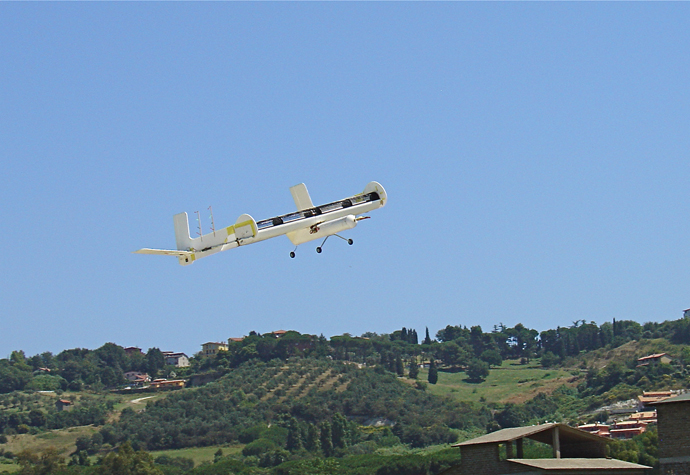
Concept The FanWing is a distributed-propulsion aircraft with a trapped vortex inside the rotor cage. A cross-flow fan near the leading edge of the wing transfers the work of the engine to the air along the entire wingspan. The resulting increased lift from the trapped vortex and the rearward acceleration of a large volume of air offers very short take-off-and-landing with quiet and efficient short-haul heavy lift capability.
Safety The FanWing has safety features of no sudden stall at high angles of attack, no asymmetry if one engine fails and can auto-rotate (like a helicopter) to make a safe landing if all engines fail.
Efficiency Documented efficiencies for the first prototypes were 20 grams of lift per Watt of shaft power and later wind-tunnel tests indicated 29 g/W. Recent tests of a large-scale model have enabled the ‘fan scaling laws’ to be established for this novel configuration and this allows performance predictions of large FanWing aircraft to be made. Most recent predictions (July 2011) are that the FanWing will cover more than twice the distance of a helicopter on the same fuel load.
Speed Higher-speed wingshape modifications developed in a wind-tunnel and verified by model flight tests have resulted in new speed estimates for a 15-ton aircraft of 100kt at sea level and significantly more at altitude. These estimates will be further refined by the ongoing large-scale wind tunnel testing described later.
OHS Development (Outboard Horizontal Stabilizer) The recently developed TwinTail configuration, suggested originally by former BAE Systems Principal Concepts Engineer, George Seyfang, avoids the strong downwash flow directly behind the wing and exploits the upwash from the wingtip vortices. The new design has increased the efficiency of the aircraft by between 10 and 15% and also improved pitch stability.
Milestones
1998 First take-off/proof of concept. Initial wind-tunnel tests conducted by Pat Peebles at the University of Rome. 2002 UK Government SMART Award and private investment funded wind-tunnel tests completed at Imperial College by Peebles assisted by Klaus Kogler. Data consultation by Professor J M R Graham.
2005-2006 Ultralight Simulation Project: Imperial College funded project using X-Plane software to establish flight characteristics.See Flight simulation and testing of the FanWing experimental aircraft; Authors: Oliver Ahad, J.M.R. Graham; Journal: Aircraft Engineering and Aerospace Technology ISSN: 0002-2667 Year: 2007 Volume: 79 Issue: 2
2005 VTOL capability first confirmed on an indoor tethered model. Patents granted 2010, 2011.
2007 STOL UAV urban surveillance prototype demonstrates short-take-off of a 1 m roll without payload and 3m on lower power (see video on this website and Flight Global online archives). Estimations are that at maximum weight (12kg) the aircraft will take off in three lengths. Predicted autonomy is close to 80 minutes with a 2 kg payload under electric power.
2010 Technical collaboration on wingshape, tests and overall design initiated between Pat Peebles and George Seyfang, formerly Principal Concept Engineer at BAe Systems.
2012 Project begun to design and construct first manned twin-tailed ultralight in collaboration with George Seyfang and Richard Jenkins (Greenbird & SailDrone project) Completion for first flight (planned for Oshkosh) delayed by lack of funds. First wing section constructed 2013 and successfully tested for speed and efficiency.
Recent Developments
A two-year research and development project is now ongoing based on a European Union FP7 Funding Award granted to FanWing Ltd. as part of a consortium formed, led and administrated by the German DLR Aerospace Centre (Deutsches Zentrum für Luft- und Raumfahrt) and including the University of Saarland, Germany, and the Von Karman Institute, Belgium. The R&D 'SOAR' project aims to optimise the wingshape and fan-blade configuration with the final goal of establishing the technical and economic feasibility of eventual development into a full-size cargo lifter.
Abstract from the EU proposal 2013
The SOAR open-fan wing technology at the focus of this project is a new concept that distributes the thrust and powered-lift over the entire span of the wing resulting in a model-proven lift efficiency three times that of helicopters as well as truly quiet U-STOL performance and safe autorotation landing.
Wind tunnel testing augmented by CFD simulations during the SOAR programme are expected to bring improvements in lift efficiency, flight speed and cruise economy on the order of 10% to 20% relative to those seen on small-scale wind tunnel and flight models.
The experimental data collected in this programme will be incorporated in two aircraft design studies targeting a transport aircraft with about eight tons of freight capacity and a passenger aircraft for 60-70 passengers. These two aircraft projections, based on the same wing and propulsion system, will subsequently be evaluated in terms of their direct operating cost in comparison with competing types such as conventional STOL aircraft, helicopters and Tilt-rotor aircraft.
It is believed that the SOAR open-fan wing technology, to be developed during this programme, will provide significant technical data at a much larger scale than previously; and this will eventually lead to a new class of aircraft with attractive operational and economic features.